
Recent posts


ANY.RUN has expanded access to Threat Intelligence capabilities for SOC and MSSP teams, backed by live attack data from 15,000 organizations.
Here’s how your team can test TI’s impact on triage quality, response speed, and threat hunting workflows.
See How Threat Intelligence Accelerates Your SOC
ANY.RUN now offers 20 premium requests in Threat Intelligence Lookup and YARA Search as part of the Free plan.
You can get immediate threat context for over 40 types of IOCs, IOBs, and IOAs belonging to the latest malware & phishing attacks. All data is sourced from real sandbox investigations by ANY.RUN’s community of 15,000 organizations and 600,000 security analysts and experts.
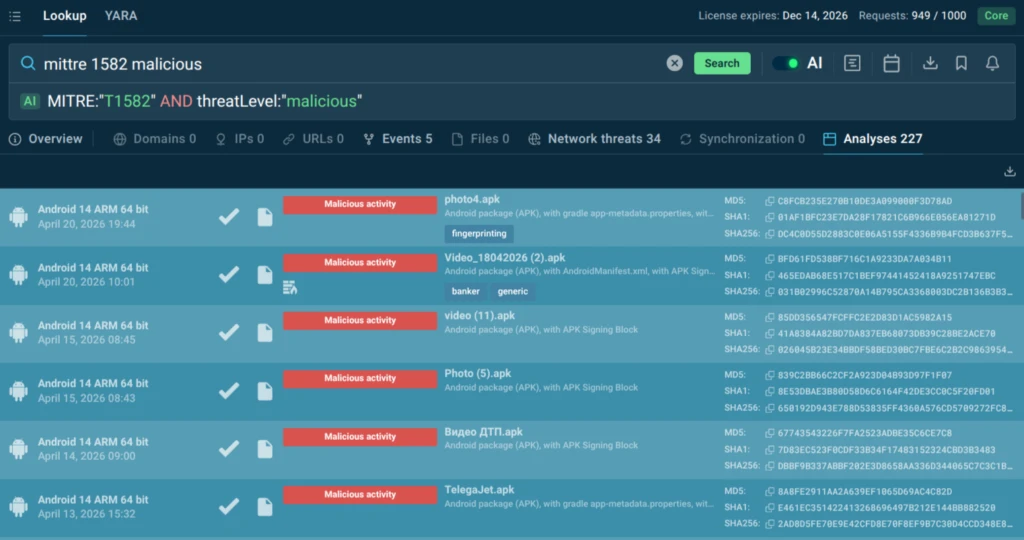
AI-assisted search is available directly in the query flow, allowing analysts to use natural language and move from question to results without manual query building.
With this expanded access, SOC and MSSP teams can explore Threat Intelligence capabilities in their workflows and see how it affects core SOC processes for faster and more confident operations:
- Reduce triage time: Validate alerts against ANY.RUN’s threat database to get immediate verdicts, full context, and access to related samples and activity.
- Improve response accuracy: Pivot from a single indicator to connected infrastructure, artifacts, and behavior to understand how the attack unfolds and what else needs containment.
- Run more effective threat hunts: Test hypotheses against live attack data, find related samples with YARA Search, and confirm relevance before expanding the hunt.
- Build detections based on real attacks: Use discovered patterns and artifacts to create or refine detections aligned with current malware and phishing activity.
This directly impacts key SOC metrics, including reduced time per investigation, lower escalation rates, and faster Mean Time to Respond.
AI Search for Streamlined Investigations
To speed up investigations and simplify how analysts work with Threat Intelligence, TI Lookup now includes AI-assisted search directly in the search bar.
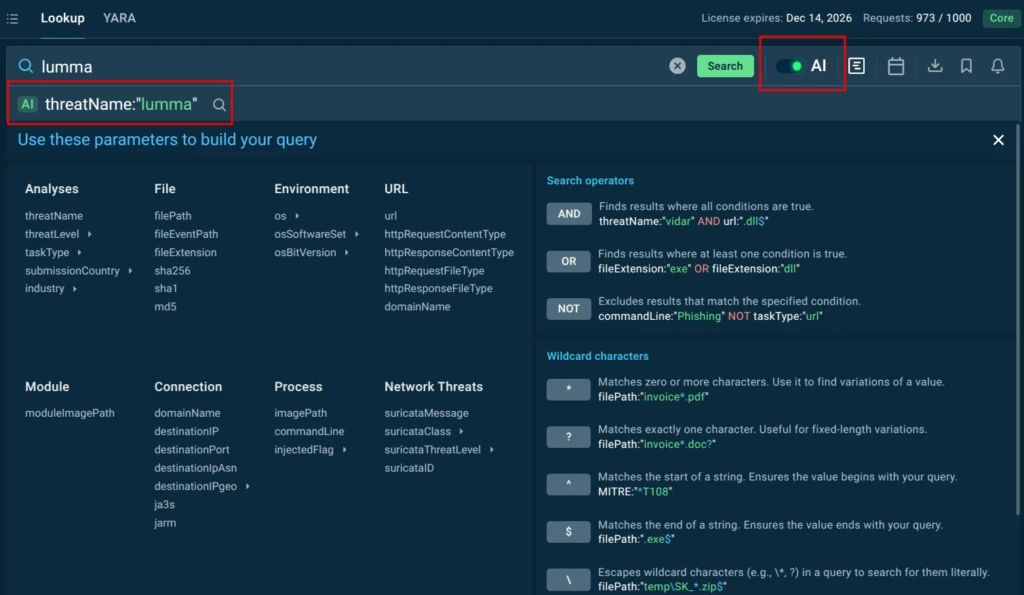
Analysts can use natural language to query data, while the system automatically translates requests into structured queries with the correct parameters and wildcards.
This removes time spent on query construction and reduces friction in the workflow. Analysts move faster from alert to context, run more queries in less time, and get consistent results without additional steps.
Fueling Core SOC Workflows
Threat intelligence becomes truly valuable when it integrates into everyday operations. Here’s how it reinforces the three pillars of any SOC.
1. Triage: From Guesswork to Confident Decisions
Alert volume is the defining operational challenge for most SOC teams. The ability to validate an alert quickly and to make a confident decision about whether to close it or escalate directly determines how efficiently a team can operate.
With ANY.RUN’s threat intelligence, analysts can immediately check an incoming indicator against a broad base of real-world attack data. Known-malicious infrastructure, recognized malware patterns, and previously documented campaigns can be matched in seconds. This means:
- Faster, evidence-backed decisions on alert validity;
- A measurable reduction in the percentage of escalations driven by uncertainty rather than confirmed risk;
- Lower analyst cognitive load during high-volume periods.
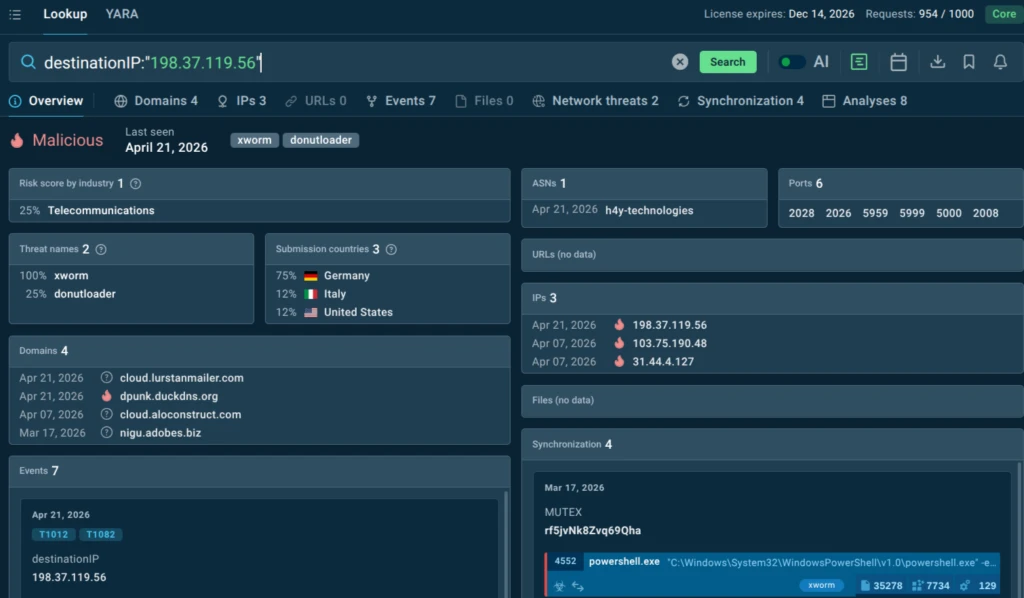
Analysts spend less time on inconclusive alerts and more time on confirmed threats. With documented context to support every decision.
2. Response: Seeing the Bigger Picture
Once an incident is confirmed, speed and precision matter. The quality of the response depends on how well the team understands the threat: its connections, its infrastructure, its behavioral patterns, and its likely next moves. Two clicks in TI Lookup search results cited above take your analyst to a sandbox session of malware detonation and attack chain exposure:
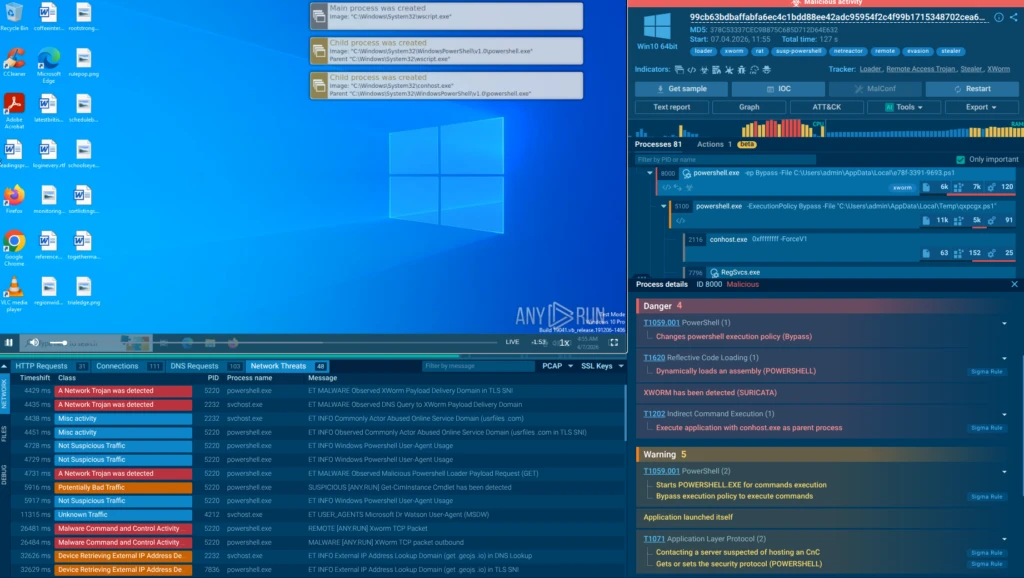
ANY.RUN’s threat intelligence enables response teams to map the relationships between indicators and the broader campaigns or actor groups behind them. Shared infrastructure, overlapping TTPs, and connected artifacts can be identified quickly, giving responders a structural understanding of what they are dealing with, not just a list of individual indicators.
This translates into:
- More complete scoping of incidents, with fewer blind spots;
- Targeted containment and remediation actions grounded in evidence;
- Higher confidence in response decisions.
Overreaction and underreaction are reduced at the same time. The response becomes targeted, not reactive.
3. Threat Hunting: Testing Hypotheses Against Reality
Proactive threat hunting requires the ability to test hypotheses against real-world data. Analysts need to move from a suspicion about adversary behavior to a confirmed or refuted finding with enough evidence to act.
ANY.RUN’s threat intelligence gives hunters access to a rich, searchable base of behavioral data from real-world malware analysis. Campaign linkages, attacker infrastructure patterns, and behavioral signatures can all be researched in depth.
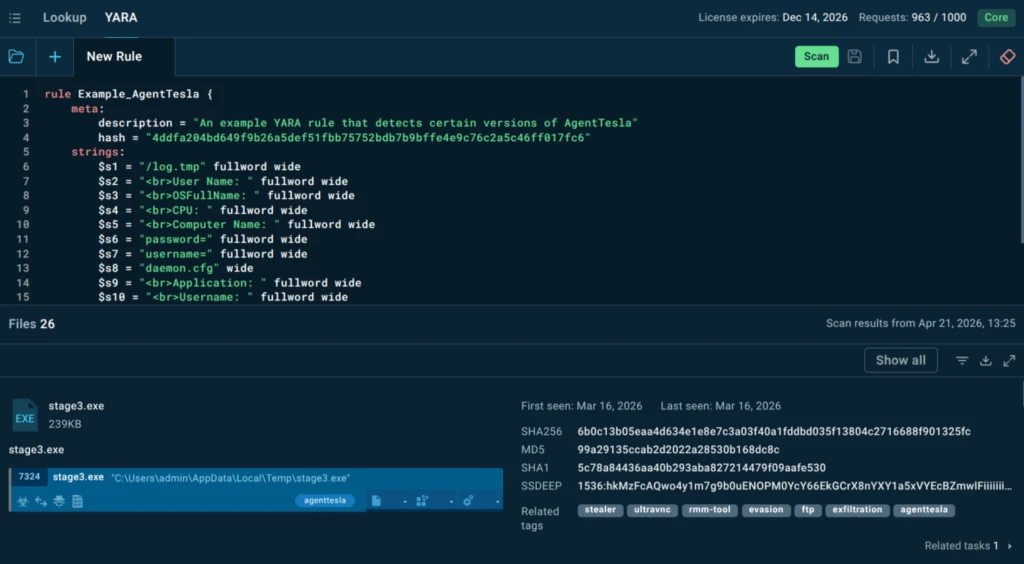
YARA Rules Search adds a further dimension, allowing hunters to build and validate detection logic against current threat data.
The result is a hunting capability that is grounded in current, real-world evidence rather than theoretical models. It enables teams to find genuine threats and build detection coverage that reflects how adversaries actually behave. Hunting shifts from speculative to evidence-driven.
How Threat Intelligence Impacts Your Business Outcomes
Behind every alert, investigation, and response action, there is a business impact quietly accumulating.
For Security Operations Teams (SOCs & MSSPs):
- Alert validation accelerates, reducing the time from detection to decision.
- Fewer escalations are driven by uncertainty; each escalation carries stronger evidentiary weight.
- Investigation time decreases as analysts access contextualized data without pivoting between tools.
- Analyst confidence improves, reducing the hesitation that slows response in high-pressure situations
For the Organization:
- Incident costs fall when threats are understood accurately and responded to precisely.
- Faster response timelines limit attacker dwell time and reduce the scope of potential damage.
- The risk of missing significant threats decreases as detection and investigation are backed by broad, current intelligence.
- Security investments deliver more measurable returns when team capacity is focused on real, confirmed risk.
Scale SOC Performance with Full Access to Threat Intelligence from ANY.RUN
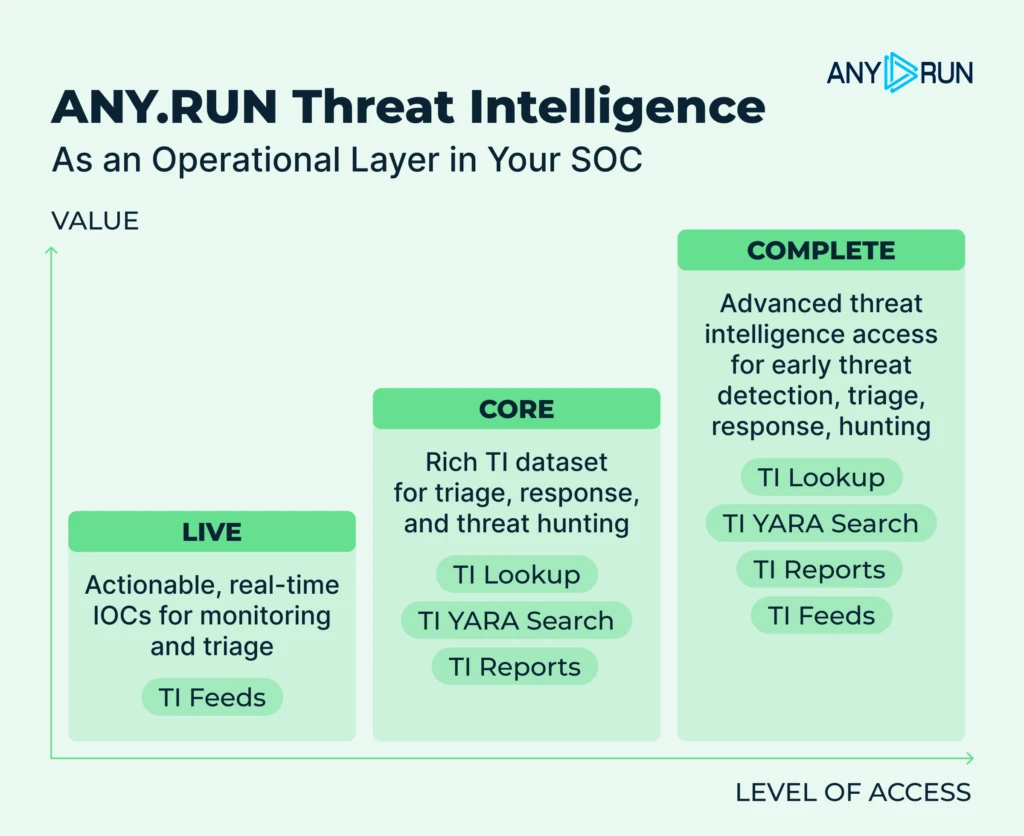
The Free plan is a genuine starting point: a full-capability evaluation that lets teams verify the value of ANY.RUN’s intelligence on real workflows. For organizations ready to operationalize threat intelligence at scale, ANY.RUN offers paid plans designed for different operational needs.
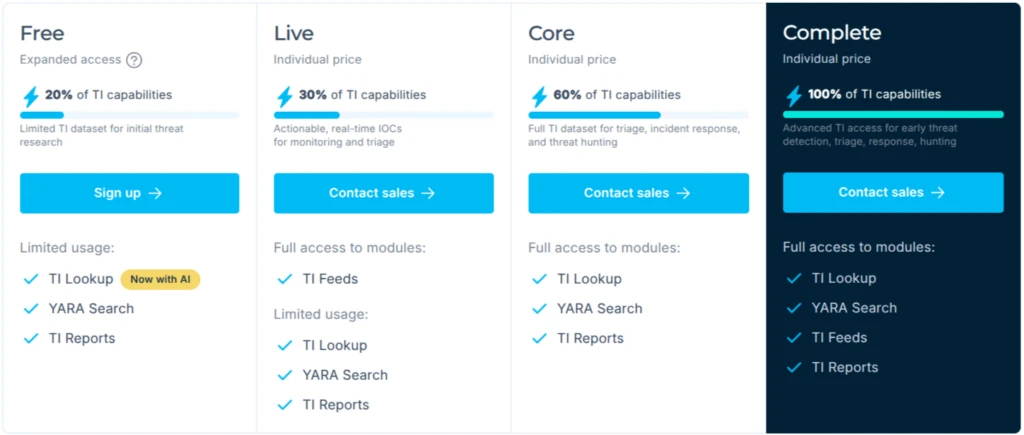
These include Live, Core, and Complete plans, allowing teams to choose the level of access and integration that fits their workflows and scale.
Across these plans, organizations can leverage the full set of threat intelligence capabilities, including:
1. Threat Intelligence Feeds
Continuous streams of validated indicators enriched with behavioral context from the sandbox analyses, delivered directly into SIEM, EDR, IDS/IPS, and SOAR systems. This enables automated enrichment and faster detection pipelines.
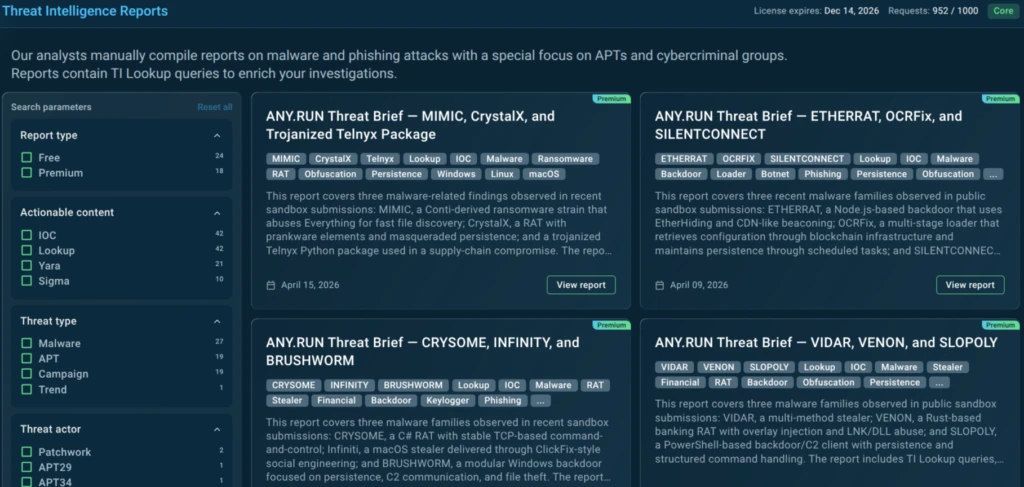
2. Threat Intelligence Reports: full access
Structured analyses of active campaigns, malware families, and attacker techniques. These reports provide ready-to-use insights for both operational response and strategic planning.
What makes them particularly useful in operations:
- Clear breakdowns of campaigns, including tactics, techniques, and procedures;
- Context around how attacks unfold in real environments;
- Indicators and infrastructure tied together into meaningful clusters;
- Ready-to-use insights that support both immediate response and long-term defense.
Reports act as a bridge between raw telemetry and strategic understanding. They help teams not only react faster, but also recognize patterns before they escalate into incidents.
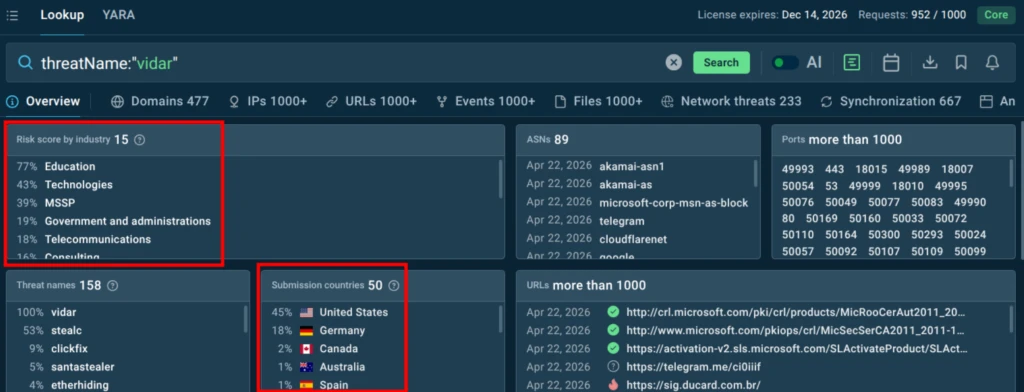
3. Threat Landscape
A contextual layer that maps threats to industries and geographies, helping organizations understand where specific risks are most relevant to their business.
Together, these capabilities support key business objectives:
- Reducing mean time to detect and respond (MTTD/MTTR);
- Lowering operational costs of incident handling;
- Improving analyst efficiency and capacity utilization;
- Strengthening risk management and compliance posture.
The result is a measurable improvement in how security operations contribute to overall business resilience.
Final Thoughts
The gap between threat detection and effective response is not primarily a technology problem. It is a data problem. When analysts have access to rich, current, contextual intelligence at the moment they need it, decisions improve and outcomes follow.
ANY.RUN’s unified threat intelligence — TI Lookup, TI Feeds, TI Reports, and YARA Search, all powered by real sandbox data from 15,000 organizations — gives SOC and MSSP teams that foundation. The free plan removes the evaluation barrier: any team can run it through real workflows, on real alerts, before committing to anything.
For teams that operationalize it, the cumulative effect is a SOC that is measurably faster, more accurate, and more confident — and an organization that is measurably harder to compromise and cheaper to defend.
About ANY.RUN
ANY.RUN, a leading provider of interactive malware analysis and threat intelligence solutions, helps security teams investigate threats faster and with greater clarity across modern enterprise environments.
It allows teams to safely execute suspicious files and URLs, observe real behavior in an Interactive Sandbox, enrich indicators with immediate context through TI Lookup, and monitor emerging malicious infrastructure using Threat Intelligence Feeds. Together, these capabilities help reduce investigation uncertainty, accelerate triage, and limit unnecessary escalations across the SOC.
ANY.RUN is trusted by thousands of organizations worldwide and meets enterprise security and compliance expectations. It is SOC 2 Type II certified, demonstrating its commitment to protecting customer data and maintaining strong security controls.
It includes 20 investigations in Threat Intelligence Lookup with AI-assisted search, access to YARA search, and the free Threat Intelligence Reports to evaluate real workflows.
It is not a limited demo. It allows teams to test threat intelligence directly within their SOC processes, using real alerts and investigations.
It is generated from real-world malware analyses in the ANY.RUN Interactive Sandbox, enriched with behavioral data, infrastructure links, and campaign context.
It simplifies query building by translating intent into structured search parameters, reducing time spent on syntax and accelerating investigations.
Yes, paid plans support integration with SIEM, SOAR, and other security systems, enabling automated workflows and enrichment.
SOC teams, MSSPs, and security leaders who want to improve decision speed, reduce uncertainty, and lower incident response costs.



0 comments