Black friday Up to 3 extra licenses FOR FREE + Special offer for TI LOOKUP Get it now
Webinar
February 26
Better SOC with Interactive Sandbox Practical Use Cases
Register now

Fabookie

129
Global rank
156 infographic chevron month
Month rank
141 infographic chevron week
Week rank
0
IOCs

Fabookie is an infostealer malware that was first observed as early as October 2021. The threat is known for targeting account credentials of Facebook users. The collected information is then sold by the attackers to other criminals. Fabookie is often distributed via loaders such as SmokeLoader.

Stealer
Type
Unknown
Origin
1 October, 2021
First seen
10 December, 2025
Last seen

How to analyze Fabookie with ANY.RUN

Type
Unknown
Origin
1 October, 2021
First seen
10 December, 2025
Last seen

IOCs

IP addresses
95.86.21.52
213.6.54.58
201.119.15.212
109.73.242.14
187.140.86.116
187.134.87.130
95.154.196.56
5.42.78.22
181.230.206.248
189.143.158.99
179.43.155.195
183.100.39.157
190.219.153.101
79.137.205.112
104.47.53.36
193.106.175.148
187.204.8.141
201.124.98.97
60.246.82.1
37.34.248.24
Domains
facebook.websmails.com
aliyunstore.site
a4051b3f.site
aliyuncom.site
carrieremaken.com
adriaenclaeys.ta.imgjeoogbb.com
ww.hackacademy.me
nordskills.eu
clicktotrust.com
apps.ecrubox.com
astoriaresidency.com
as.imgjeoigaa.com
9e4491e7-99ad-40dd-9249-b07029fc7dd4.uuid.cdneurops.shop
paraslegal.com
server5.mastiakele.xyz
erpibex.com
580af1f8-4a49-4f1b-b74f-2aa299655155.uuid.zaoshanghao.su
fastprivate.me
zaoshanghao.sucvwwajk56uu2la7jl4e2fdxy56veg5hqlaondeb7whvy2vlmreq6jnid.onion
zaoshanghao.sucvwwajk56uu2la7jl4e2fdxy56veg5hqlaondeb7whvy2vlmreq6jnid.onioncommonpro
Last Seen at
Last Seen at

Recent blog posts

post image
How Threat Intelligence Helps Protect Financi...
watchers 370
comments 0
post image
Release Notes: Workflow Improvements, MISP In...
watchers 2124
comments 0
post image
Enterprise Phishing: How Attackers Abuse Trus...
watchers 4166
comments 0

What is Fabookie malware?

Fabookie is a malicious software categorized as an information stealer. It primarily targets Facebook Business accounts, aiming to steal sensitive data like login credentials and account information.

This stolen data can then be exploited by attackers for various malicious purposes. Fabookie operates discreetly, running silently in the background without the user's knowledge, making it a significant threat to unsuspecting victims.

Fabookie primarily targets devices running 64-bit operating systems. Security researchers estimate over 100,000 infected machines worldwide, highlighting its widespread reach.

Use ANY.RUN free for 14 days

Try the full power of interactive analysis

Start your free trial

Technical details of the Fabookie malicious software

The primary capabilities of Fabookie include:

  • Credential theft (T1552): Fabookie searches infected machines for saved passwords, browser cookies containing login sessions, and other cached authentication information.
  • System information gathering (T1518): Beyond credentials, Fabookie may gather details about the system it infects. This information, such as installed software and hardware specifications, could be used to further exploit vulnerabilities or tailor future attacks.
  • Facebook Interaction (T1071): Once it acquires credentials, Fabookie interacts with the Facebook API. This allows the malware to extract additional information about the targeted Facebook Business account, including payment methods and account balances.
  • Command-and-Control Communication: The stolen data is then transmitted to a remote server controlled by the attackers.

Similar to other malware families, such as Amadey and RisePro, Fabookie is capable of ensuring persistence on the system by remaining active even after a reboot.

One notable feature of Fabookie is that it exploits .jpeg images to deliver malicious code.

Execution process of Fabookie

Let’s observe the execution process of the Fabookie malware by uploading its sample to ANY.RUN for analysis.

The Fabookie stealer infiltrates systems through various means such as malicious websites or phishing emails. Once installed, it silently collects sensitive information like login credentials and credit card details from the infected device. This data is then transmitted to remote servers controlled by the attackers. To remain undetected, Fabookie employs persistence techniques and may allow remote access for further malicious activities.

In our example, the execution chain of this stealer is straightforward. Once Fabookie initiates its own child process, it proceeds with its malicious activities centered around stealing credentials, cookies, and other valuable information from web browsers. The stealer collects this data and sends it to the C2 (Command and Control) server for remote access and further exploitation.

Overall, the execution chain of the Fabookie stealer is designed to silently compromise systems, steal valuable data, and maintain control for as long as possible without raising suspicion.
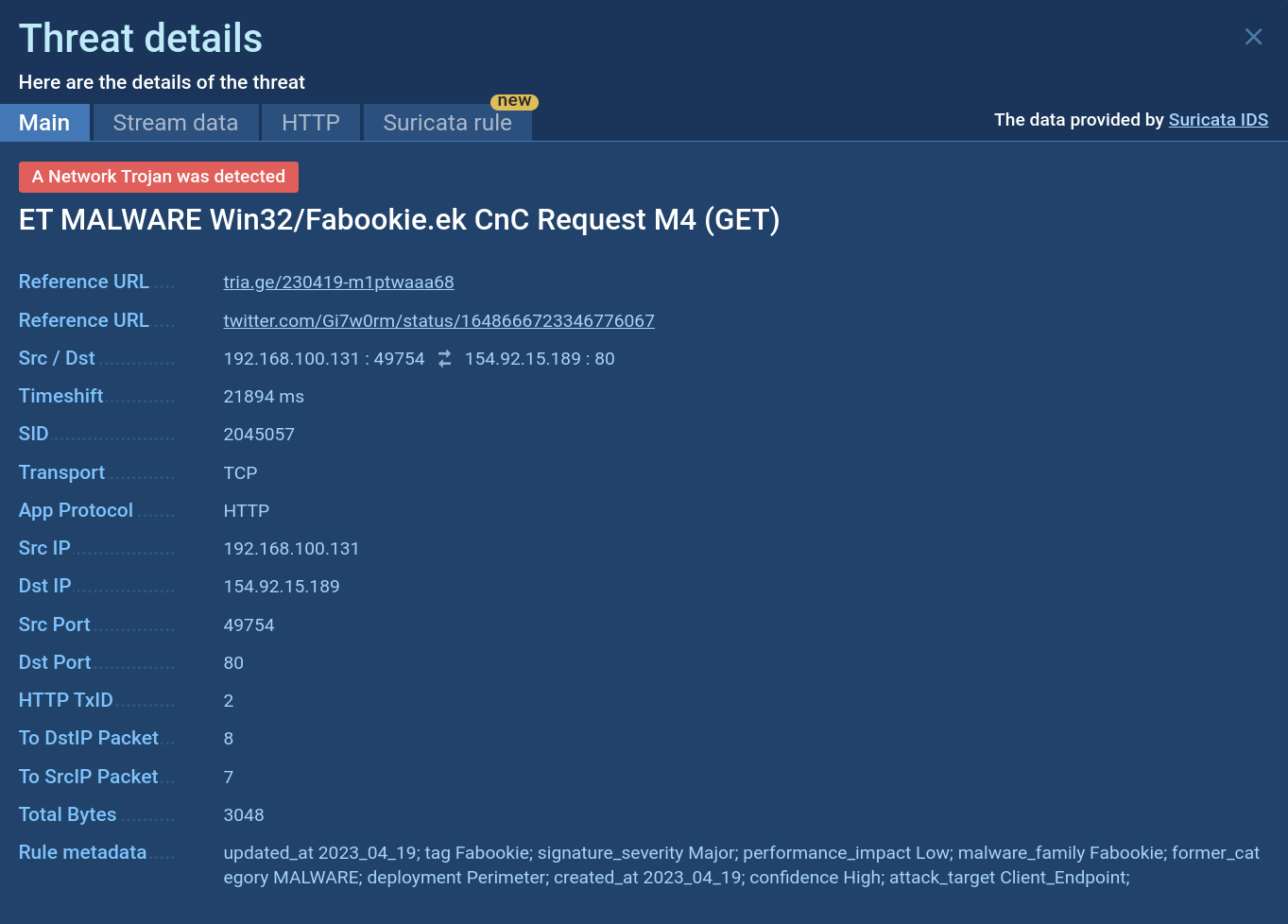
Fabookie Suricata rule shown in ANY.RUN Fabookie Suricata rule demonstrated in ANY.RUN

Distribution methods of the Fabookie malware

Attackers employ various ways of distributing Fabookie. One of the most common ones is via special loader malware that first penetrates defense systems of endpoints and delivers Fabookie to them. NullMixer and SmokeLoader are two examples of such loader malware.

Alternatively, Fabookie can be spread through spam emails that are crafted in a way to appear legitimate to users. These emails usually contain phishing links and files which eventually lead to the infection with Fabookie.

Conclusion

Fabookie is just one example of the ever-evolving threat landscape. By understanding its capabilities and implementing these protective measures, you can significantly reduce your risk of falling victim to such attacks and safeguard your sensitive information.

The ANY.RUN sandbox provides a cloud-based environment for analyzing files and links suspected of being malicious. It effectively identifies threats like Fabookie and generates reports summarizing the detected malware's technical characteristics, including TTPs and IOCs.

Try ANY.RUN for free – request a demo!
HAVE A LOOK AT

Keylogger screenshot
Keylogger
keylogger
A keylogger is a type of spyware that infects a system and has the ability to record every keystroke made on the device. This lets attackers collect personal information of victims, which may include their online banking credentials, as well as personal conversations. The most widespread vector of attack leading to a keylogger infection begins with a phishing email or link. Keylogging is also often present in remote access trojans as part of an extended set of malicious tools.
Read More
Cactus Ransomware screenshot
Cactus ransomware-as-a-service (RaaS) was first caught in March 2023 targeting corporate networks. It became known for its self-encrypting payload and double extortion tactics. Cactus primarily targets large enterprises across industries in finance, manufacturing, IT, and healthcare. It is known for using custom encryption techniques, remote access tools, and penetration testing frameworks to maximize damage.
Read More
HijackLoader screenshot
HijackLoader
hijackloader
HijackLoader is a modular malware acting as a vehicle for distributing different types of malicious software on compromised systems. It gained prominence during the summer of 2023 and has since been used in multiple attacks against organizations from various sectors, including hospitality businesses.
Read More
Phobos screenshot
Phobos
phobos ransomware
Phobos is a ransomware that locks or encrypts files to demand a ransom. It uses AES encryption with different extensions, which leaves no chance to recover the infected files.
Read More
Salvador Stealer screenshot
Salvador Stealer
salvador
Salvador Stealer is a powerful, information-stealing Android malware designed to silently infiltrate systems, extract sensitive data, and exfiltrate it to cybercriminals. Often sold on underground forums, it is part of the growing ecosystem of “stealers-as-a-service” (SaaS) tools that target individuals and organizations alike.
Read More
Gunra screenshot
Gunra
gunra
Gunra ransomware, a financially motivated threat actor that emerged in April 2025, deploys double-extortion tactics to encrypt victims' data and threaten leaks of exfiltrated information, primarily targeting Windows and Linux systems across healthcare, manufacturing, and other sectors worldwide.
Read More