Black friday Up to 3 extra licenses FOR FREE + Special offer for TI LOOKUP Get it now
Webinar
February 26
Better SOC with Interactive Sandbox Practical Use Cases
Register now

PureLogs

63
Global rank
38 infographic chevron month
Month rank
34 infographic chevron week
Week rank
0
IOCs

PureLogs is a stealer that collects a wide range of data from infected systems, including browser data, crypto wallets, PC configuration details, etc. It is delivered by PureCrypter, another malware that belongs to the Pure malware family. PureLogs is distributed based on a subscription model, allowing any threat actor to utilize it in their attacks.

Stealer
Type
ex-USSR
Origin
1 March, 2022
First seen
5 February, 2026
Last seen

How to analyze PureLogs with ANY.RUN

Type
ex-USSR
Origin
1 March, 2022
First seen
5 February, 2026
Last seen

IOCs

IP addresses
176.65.139.19
139.99.17.175
89.238.176.5
91.92.249.233
104.243.32.185
161.97.110.15
193.161.193.99
213.209.143.50
89.238.176.4
84.38.132.39
87.120.84.140
31.220.90.137
91.92.120.101
94.154.35.25
196.251.88.111
116.203.19.97
95.214.54.172
213.209.143.43
91.92.252.74
15.204.0.108
Domains
jofilesjo.com
ginten555333.com
rustercoin.com
eiseesaeheeg.fun
utente.service-fatturecloud.de
wi-fi.rip
lkvbb-lkvbb.de
fallback-01-static.com
relay-03-static.cloud
service-fatturecloud.de
sicherer-download-pdf.de
data.pornsworld.xyz
dksj.wi-fi.rip
chaifoomasho.foundation
vertextech.buzz
puredating.top
pornsworld.xyz
undernamingtry.xyz
strang-01-static.com
pdf-builder.theworkpc.com
Last Seen at
Last Seen at

Recent blog posts

post image
How Threat Intelligence Helps Protect Financi...
watchers 412
comments 0
post image
Release Notes: Workflow Improvements, MISP In...
watchers 2216
comments 0
post image
Enterprise Phishing: How Attackers Abuse Trus...
watchers 4315
comments 0

What is malware: PureLogs Stealer?

PureLogs is a stealer malware that is part of the Pure ecosystem of products. This malware family, which includes PureCrypter and other tools, was first distributed in March 2021. It is offered as malware-as-a-service (MaaS) meaning that different threat actors can freely purchase access to this malware

The Pure malware family products are sold openly on the developer’s website and forums. Despite being promoted as software for testing purposes, it is widely employed for malicious activities.

PureCrypter, another tool in the Pure ecosystem, is often used in conjunction with PureLogs. PureCrypter is tasked with encrypting malicious payloads and delivering them to the victim’s system.

Get started today for free

Analyze malware and phishing in a fully-interactive sandbox

Create free account

PureLogs Stealer malware technical details

PureLogs Stealer is designed to collect a wide range of data from infected systems:

  • Browser Data: PureLogs Stealer collects including browsing history, cookies, autofill data from Chrome and other Chromium- and Gecko-based browsers.
  • Crypto Wallets: The malware targets cryptocurrency wallets, including browser (MetaMask, Trust Wallet) and desktop ones (Exodus, Electrum), stealing private keys.
  • Complete User Information: PureLogs Stealer collects usernames, passwords, email addresses, and other personal data.
  • Full PC Configuration Details: The malware gathers info about the infected system's hardware and software configuration, such as OS and CPU details.
  • Application Data: The malware can hijack apps like FileZilla, Telegram, and more.
  • File Grabbing: The malware can locate and exfiltrate files by folder path and extension.
  • Clipboard Data: It can monitor the clipboard and steal any data that is copied and pasted.
  • Screenshots: The malware can take screenshots of the infected system's desktop.
  • Keylogging: PureLogs Stealer can record keystrokes, allowing cybercriminals to steal login credentials, and other information entered by the victim.

The malware uses PureCrypter, a loader that is capable of delivering staged and stage-less payloads. The loader has also been observed to drop third-party malware, such as AgentTesla.

Learn more about the Pure Malware family in ANY.RUN’s article “A Full Analysis of the Pure Malware Family: Unique and Growing Threat”.

The malware can gain persistence on the system via Registry Run Keys. It is also capable of removing itself via a PowerShell command.

PureLogs Stealer uses TCP/IP communication with its Command and Control (C2) server. It encrypts the data which it exfiltrates from the infected system.

PureLogs Stealer execution process

We can conduct an in-depth analysis of a PureLogs sample in the ANY.RUN sandbox.

PureLogs begins its execution chain by infecting a host machine, typically through phishing emails or malicious downloads.

Once on the host, it unpacks itself to deploy the payload, often avoiding detection by employing techniques such as encryption or obfuscation.

The stealer then scans the infected system for valuable data, such as credentials, financial information, and other sensitive personal data. This information is extracted and often encrypted to ensure it is securely transmitted back to the command and control (C2) server. Throughout this process, PureLogs maintains communication with the C2 server to receive further instructions and update its operational parameters.

Finally, the stolen data is utilized by the attackers for various malicious purposes, including identity theft, financial fraud, or selling on the dark web
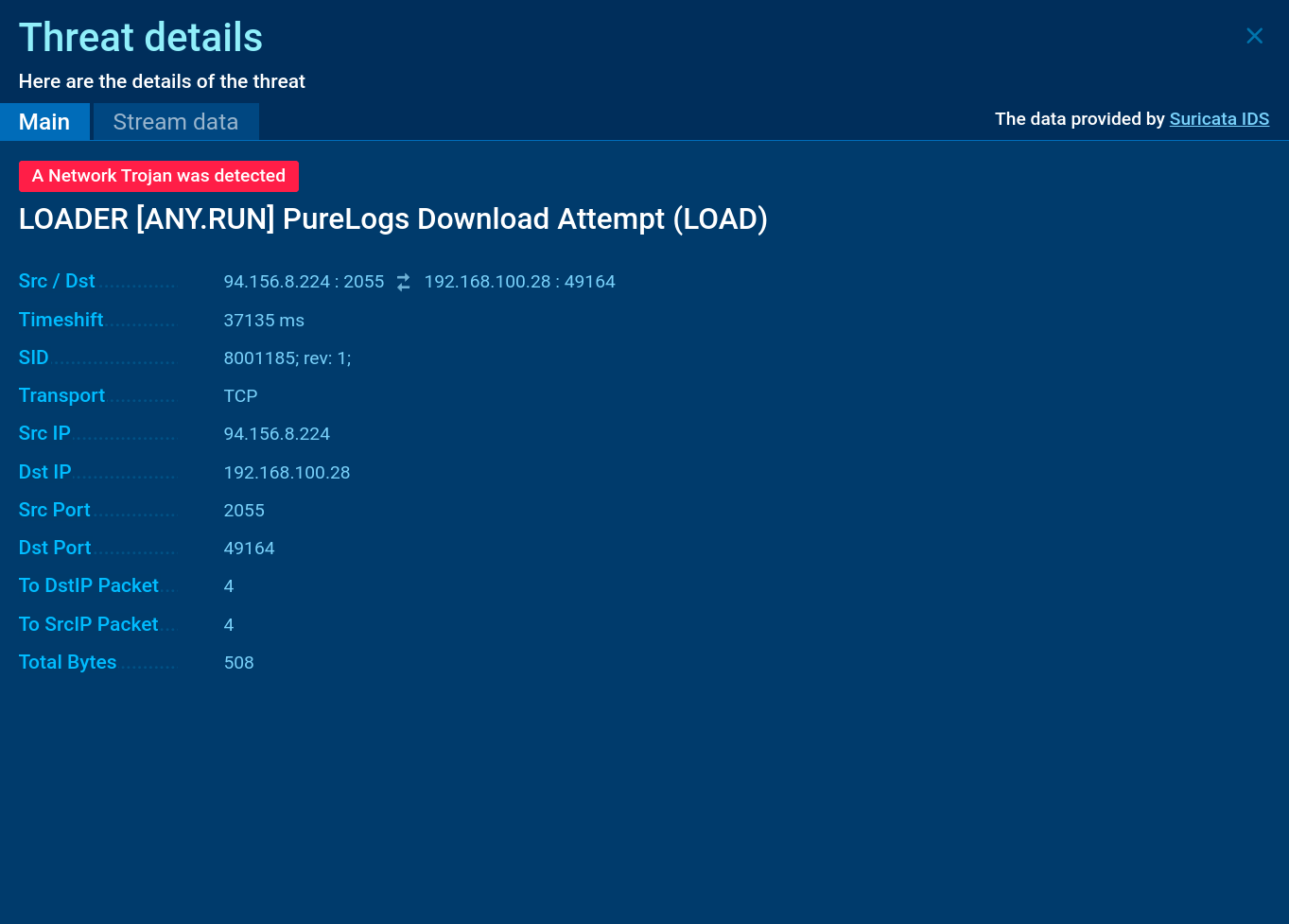
PureLogs Suricata rule in ANY.RUN PureLogs Suricata rule shown in ANY.RUN

PureLogs Stealer malware distribution methods

Since PureLogs is a MaaS stealer, different threat actors utilize their own methods for infecting victims’ devices.

Similar to Gh0stRAT and LimeRAT, some cybercriminals employ a tactic of renaming the malicious files associated with PureLogs Stealer infection to popular legitimate software and video games to trick unsuspecting users into downloading and installing the malware.

Conclusion

PureLogs Stealer's ability to collect a vast array of sensitive data coupled with a relatively low barrier to acquire it presents a significant risk to individuals and organizations. When used together with PureCrypter, this malware becomes even more challenging to detect, making it easier for cybercriminals to infect systems and compromise sensitive information.

To prevent infection, it is crucial to have a robust security infrastructure that includes sandboxing capabilities to analyze any suspicious files and links that enter the organization. By taking proactive measures, individuals and organizations can significantly reduce the risk of falling victim to PureLogs Stealer and other malware threats.

ANY.RUN, a cloud-based sandbox, provides the tools for quick, easy, and conclusive analysis of PureLogs Stealer, as well as dozens of other malware families. Thanks to ANY.RUN’s interactive approach, users can engage with the virtual environment and perform any actions needed to study the threat comprehensively. The service provides threat reports on each analyzed sample that feature indicators of compromise, TTPs, and other info that can empower users to make informed security decisions.

Create your ANY.RUN account – it’s free!
HAVE A LOOK AT

DarkVision screenshot
DarkVision
darkvision
DarkVision RAT is a low-cost, modular Remote Access Trojan that gives attackers remote control of infected Windows hosts. Initially observed around 2020 and sold in underground marketplaces, DarkVision has become notable for its full feature set (keylogging, screen capture, file theft, remote command execution and plugin support) and for being distributed via multi-stage loaders in recent campaigns.
Read More
Botnet screenshot
Botnet
botnet
A botnet is a group of internet-connected devices that are controlled by a single individual or group, often without the knowledge or consent of the device owners. These devices can be used to launch a variety of malicious attacks, such as distributed denial-of-service (DDoS) attacks, spam campaigns, and data theft. Botnet malware is the software that is used to infect devices and turn them into part of a botnet.
Read More
DarkGate screenshot
DarkGate
darkgate
DarkGate is a loader, which possesses extensive functionality, ranging from keylogging to crypto mining. Written in Delphi, this malware is known for the use of AutoIT scripts in its infection process. Thanks to this malicious software’s versatile architecture, it is widely used by established threat actors.
Read More
Spynote screenshot
Spynote
spynote
SpyNote, also known as SpyMax and CypherRat, is a powerful Android malware family designed primarily for surveillance and data theft, often categorized as a Remote Access Trojan (RAT). Originally emerged in 2016, SpyNote has evolved significantly, with new variants continuing to appear as recently as 2023–2025.
Read More
Sliver screenshot
Sliver
sliver
Sliver is an open-source command-and-control (C2) framework that has been increasingly adopted by threat actors as an alternative to tools like Cobalt Strike. Developed by security firm Bishop Fox, Sliver was initially intended for legitimate security testing and red teaming exercises. However, its robust features and open-source nature have made it attractive to malicious actors seeking to control compromised systems.
Read More
Ransomware screenshot
Ransomware
ransomware
Ransomware is a type of malicious software that locks users out of their system or data using different methods to force them to pay a ransom. Most often, such programs encrypt files on an infected machine and demand a fee to be paid in exchange for the decryption key. Additionally, such programs can be used to steal sensitive information from the compromised computer and even conduct DDoS attacks against affected organizations to pressure them into paying.
Read More