Black friday Up to 3 extra licenses FOR FREE + Special offer for TI LOOKUP Get it now
Webinar
February 26
Better SOC with Interactive Sandbox Practical Use Cases
Register now

Lu0Bot

124
Global rank
88 infographic chevron month
Month rank
76 infographic chevron week
Week rank
0
IOCs

Lu0Bot is a Node.js malware that was first discovered in February 2021. It is a type of Trojan that primarily acts as a stealer by responding to commands from a command-and-control (C2) server and transmitting encrypted system data. It can also operate as a DDoS bot. Lu0Bot employs multiple obfuscation techniques to avoid detection and make analysis more difficult.

Trojan
Type
Unknown
Origin
1 February, 2021
First seen
7 February, 2026
Last seen

How to analyze Lu0Bot with ANY.RUN

Type
Unknown
Origin
1 February, 2021
First seen
7 February, 2026
Last seen

IOCs

IP addresses
5.188.206.211
45.141.26.119
45.141.27.41
Hashes
9c5898b1b354b139794f10594e84e94e991971a54d179b2e9f746319ffac56aa
Domains
dmz24.fun
zdm85.shop
pom39.fun
fuk09.fun
tes03.xyz
fast-difficult.monster
hri9.xyz
vhi46.shop
oun96.fun
hri2.xyz
xdk03.fun
hri10.xyz
llw18.fun
cdh80.fun
xio23.com
ykf88.fun
byk31.shop
irj55.shop
lu0.viewdns.net
zgg58.shop
Last Seen at
Last Seen at

Recent blog posts

post image
How Threat Intelligence Helps Protect Financi...
watchers 393
comments 0
post image
Release Notes: Workflow Improvements, MISP In...
watchers 2155
comments 0
post image
Enterprise Phishing: How Attackers Abuse Trus...
watchers 4212
comments 0

What is Lu0Bot malware?

Lu0Bot is a trojan that was first observed in 2021. Although less widely used than other trojan malware, such as Agent Tesla, it has the potential to inflict serious damage on infected systems.

A notable feature of Lu0Bot is its use of Node.js, an unusual programming language choice for malware. However, this unconventional approach provides Lu0Bot with versatility compared to most malicious programs that are usually developed using the .NET framework, which is limited to Windows systems.

Despite being a highly capable threat, Lu0Bot has a relatively low level of activity. Currently, its primary function is data harvesting, but it can also be used as a DDoS attack bot and may have other capabilities.

Use ANY.RUN free for 14 days

Try the full power of interactive analysis

Start your free trial

Technical details of the Lu0Bot malicious software

Once Lu0Bot is fully deployed on the system, it can engage in:

  • Keystroke recording: It can perform keylogging and record the keys that are pressed by the user, for instance, when they enter their login credentials.
  • Identity theft: It can steal the victim’s personal information, including credit card numbers and other sensitive data.
  • System control: Using Lu0Bot, attackers can execute a wide variety of activities, as the malicious software is capable of establishing near-full control over the device.
  • DDoS attacks: The malware can exploit the compromised system and use it to participate in a distributed denial-of-service (DDoS) attack.

Lu0Bot is highly obfuscated, meaning that its code is deliberately made difficult to read and understand in order to prevent or obstruct analysis. It uses several encryption algorithms, including custom ones.

By comparing Lu0Bot samples from 2021 and 2023, it becomes clear that the software is being continuously updated by its developers.

Read a detailed analysis of a Lu0Bot sample in our blog.

Execution process of Lu0Bot

In order to see how Lu0Bot operates and collect up-to-date IOCs, let’s examine one of its samples in the ANY.RUN sandbox.

Analyze malware for free in a fully interactive cloud sandbox – sign up now!

The execution chain of this malware family is relatively straightforward. After the payload executes, it uses CMD to copy and initiate the main malware process. This process is responsible for carrying out all malicious activities, including data theft, C&C server communication, and, in this case, gathering process information using WMIC.EXE.
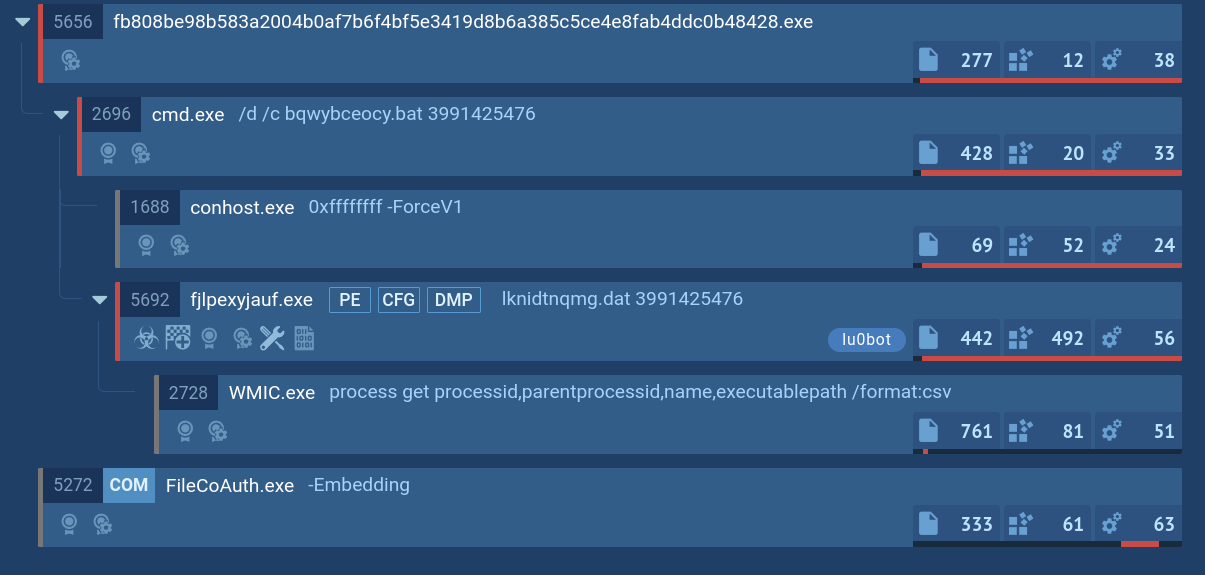
Lu0botprocess tree shown in ANY.RUN Lu0Bot's process tree demonstrated in ANY.RUN

Distribution methods of the Lu0Bot malware

In the early days, Lu0Bot was primarily dropped by GCleaner, a specialized software for deploying second-stage payloads. Yet, today, the main method of delivery for this malware is phishing emails. Essentially, attackers employ various social engineering techniques in order to get their victims to download malicious email attachments or open unsafe links and trigger the infection chain reaction on their systems.

Conclusion

Despite being a known threat, the true scale of Lu0Bot's operations remains unknown. This makes it a dangerous malware capable of dealing a significant blow to any infrastructure, if not addressed proactively. Therefore, organizations must implement proper security measures to prepare for Lu0Bot attacks.

One of the most effective ways to prevent a Lu0Bot attack is to check any incoming files and links, especially those sent by unknown senders, in the ANY.RUN sandbox. It is a malware sandbox that lets you quickly understand if the file or link your are dealing with is malicious or not.

ANY.RUN is fully interactive, enabling you to engage with the infected system like you would on your own computer but in a safe cloud environment to fully understand the behavior of the malware. It also provides comprehensive reports that include IOCs and malware configs.

Try ANY.RUN for free – request a demo!.
HAVE A LOOK AT

Meduza Stealer screenshot
Meduza Stealer is an information-stealing malware primarily targeting Windows systems, designed to harvest sensitive data such as login credentials, browsing histories, cookies, cryptocurrency wallets, and password manager data. It has advanced anti-detection mechanisms, allowing it to evade many antivirus programs. The malware is distributed through various means, including phishing emails and malicious links. It’s marketed on underground forums and Telegram channels.
Read More
Gunra screenshot
Gunra
gunra
Gunra ransomware, a financially motivated threat actor that emerged in April 2025, deploys double-extortion tactics to encrypt victims' data and threaten leaks of exfiltrated information, primarily targeting Windows and Linux systems across healthcare, manufacturing, and other sectors worldwide.
Read More
INC Ransomware screenshot
INC Ransomware is a ransomware-as-a-service (RaaS) spotted in mid-2023. It targets industries like retail, real estate, finance, healthcare, and education, primarily in the U.S. and UK. It encrypts and exfiltrates data demanding a ransom. It employs advanced evasion techniques, destroys backup, and abuses legitimate system tools at all the stages of the kill chain.
Read More
Cerber screenshot
Cerber
cerber
Cerber is a Ransomware-as-a-Service (RaaS) that appeared in 2016, spread quickly and has been evolving since. It became well-known for its file encryption, offline capabilities, and sophisticated evasion techniques. It primarily targets enterprises, financial institutions, and government entities, encrypting their data and demanding ransom payments in Bitcoin. It also targets everyday users encrypting personal files (photos, documents) with the risk of their permanent loss.
Read More
FatalRAT screenshot
FatalRAT
fatalrat
FatalRAT is a malware that gives hackers remote access and control of the system and lets them steal sensitive information like login credentials and financial data. FatalRAT has been associated with cyber espionage campaigns, particularly targeting organizations in the Asia-Pacific (APAC) region.
Read More
Xeno RAT screenshot
Xeno RAT
xenorat
Xeno RAT is an open-source malware mainly distributed through drive-by downloads. The core capabilities of this threat include remote control, keystroke logging, webcam and microphone access. Equipped with advanced utilities, such as Hidden Virtual Network Computing and Socks5 reverse proxy, Xeno RAT is most frequently used in attacks against individual users.
Read More