Black friday Up to 3 extra licenses FOR FREE + Special offer for TI LOOKUP Get it now
Webinar
February 26
Better SOC with Interactive Sandbox Practical Use Cases
Register now

PlugX

120
Global rank
136 infographic chevron month
Month rank
139 infographic chevron week
Week rank
0
IOCs

PlugX is a remote access trojan that is used extensively by Chinese APTs. The malware is primarily employed for spying on victims and can perform a variety of malicious activities, such as logging users’ keystrokes and exfiltrating information from browsers.

Backdoor
Type
China
Origin
16 January, 2008
First seen
12 January, 2026
Last seen
Also known as
Destroy RAT
Kaba
Korplug
Sogu
TIGERPLUG
RedDelta

How to analyze PlugX with ANY.RUN

Type
China
Origin
16 January, 2008
First seen
12 January, 2026
Last seen

IOCs

IP addresses
50.2.160.163
Hashes
212a8859adb7a74beb51a9faac6df60edafb645f936d4b1af95d15265325d62f
85ca20eeec3400c68a62639a01928a5dab824d2eadf589e5cbfe5a2bc41d9654
4f54a6555a7a3bec84e8193d2ff9ae75eb7f06110505e78337fa2f515790a562
6c959cfb001fbb900958441dfd8b262fb33e052342948bab338775d3e83ef7f7
fe5f8f5d25c3889449de2e709bedd408d24bec46d3fa1a488745c4d79c988fab
386eb7aa33c76ce671d6685f79512597f1fab28ea46c8ec7d89e58340081e2bd
0459e62c5444896d5be404c559c834ba455fa5cae1689c70fc8c61bc15468681
7d2b846eef2bfa822b6a0cb4399127261499fedab924fb20520b6d25916c7ed4
1eba1dc1bf2c02dac48739dd2565791b225b5671370b4153368d42b46953c0a9
560055994a2290b3eb3f354afbf5ebcf4b8d78820f238eae70d76ece81b97c23
28e0bafc9b20c4a5104d558a36600098429e8ac779a46e52a28edd432e6457e2
507d49186748dd83d808281743a17fca4b226883c410ec76eb305360cbc8c091
c3159d4f85ceb84c4a0f7ea9208928e729a30ddda4fead7ec6257c7dd1984763
Domains
50.2.160.163
URLs
http://www.destroy2013.com:443/a9349fd1
http://www.destroy2013.com:443/b55b412f
http://www.destroy2013.com:443/34ef8933
http://www.destroy2013.com/41cf3b8b
http://www.destroy2013.com/a51250b0
http://www.destroy2013.com/87f793ad
http://185.239.226.61:8080/update
http://infosecvn.com:443/update
http://45.142.166.112/9b151346
http://45.142.166.112/41426740
http://45.142.166.112/1e98c71e
http://45.142.166.112:443/c4b8a314
http://45.142.166.112:443/c5b37b2e
http://45.142.166.112:443/4227ad5a
http://45.142.166.112:443/768bd560
http://vietnam.zing.photos:443/update
http://vietnam.zing.photos/update
http://103.143.209.16/poMdDDxDkOkkML/update.php
http://www.apple-net.com/update
http://cdn.6c18.com:22/update
Last Seen at

Recent blog posts

post image
How Threat Intelligence Helps Protect Financi...
watchers 393
comments 0
post image
Release Notes: Workflow Improvements, MISP In...
watchers 2155
comments 0
post image
Enterprise Phishing: How Attackers Abuse Trus...
watchers 4212
comments 0

What is PlugX malware?

PlugX is a remote access trojan (RAT) family used to gain access to and control computers. It has been around since 2008 and continues to be exploited today by advanced persistent threat (APT) groups, including Mustang Panda.

The malware is often employed for spying on victims, as it possesses a considerable set of tools that make it a go-to-option for attackers. Among other things, it can be utilized to log users’ keystrokes and exfiltrate sensitive information. As a result, PlugX has been involved in numerous attacks on organizations, primarily in Asia. However, there are also instances of attacks on private companies.

Use ANY.RUN free for 14 days

Try the full power of interactive analysis

Start your free trial

Technical details of the PlugX malicious software

Due to the fact that PlugX has been around for over a decade, the malware has undergone numerous iterations, and multiple variants have been created as a result. However, in most cases, they share similar functionality, which includes:

  • Collecting details about the operating system, hardware components, installed applications, and network settings.
  • Exfiltrating usernames, login credentials, personal information, and browsing history.
  • Recording every keystroke made on the infected system.
  • Managing processes, allowing the attackers to manipulate the system, including by turning off antivirus software.
  • Modifying registry entries, facilitating persistence on the computer.
  • Recording the screen of a compromised device.

PlugX has been known to leverage DLL side-loading to execute its malicious payload. DLL side-loading is a technique employed by malware to evade detection by traditional security measures. It involves injecting malicious code into a legitimate DLL (Dynamic Link Library) file, which is then executed by a trusted application.

Another persistence mechanism used by PlugX is the modification of the Windows Registry to kickstart its execution during every system booting.

Similar to njRAT and LimeRAT, PlugX makes use of USB-based propagation. It enables the malware to spread to other systems via infected USB devices.

Execution process of PlugX

We observe the entire execution chain of PlugX in ANY.RUN by submitting its sample for analysis.

PlugX is known for utilizing system applications and legitimate files in its attempts to evade defense mechanisms. In our example, the malware drops a legitimate ESET EHttpSrv.exe file (renamed as esetservice.exe) that is exploited to load the http_dll.dll. This DLL file has the capability to collect files from the infected system.

Expose malicious activities and get IOCs with ANY.RUN sandbox

  • Analyze malware in Windows 7, 10, and 11 VMs
  • Interact with files and links, just like on your own computer
  • Work in a private team space with your colleagues
Request 14-day free trial

The Remote Access Trojan (RAT) also exploits the dllhost process and runs an esetservice process as a service. Following privilege escalation, PlugX injects run once, establishing a connection to a Command and Control (C2) server and awaiting commands for subsequent malicious activities.
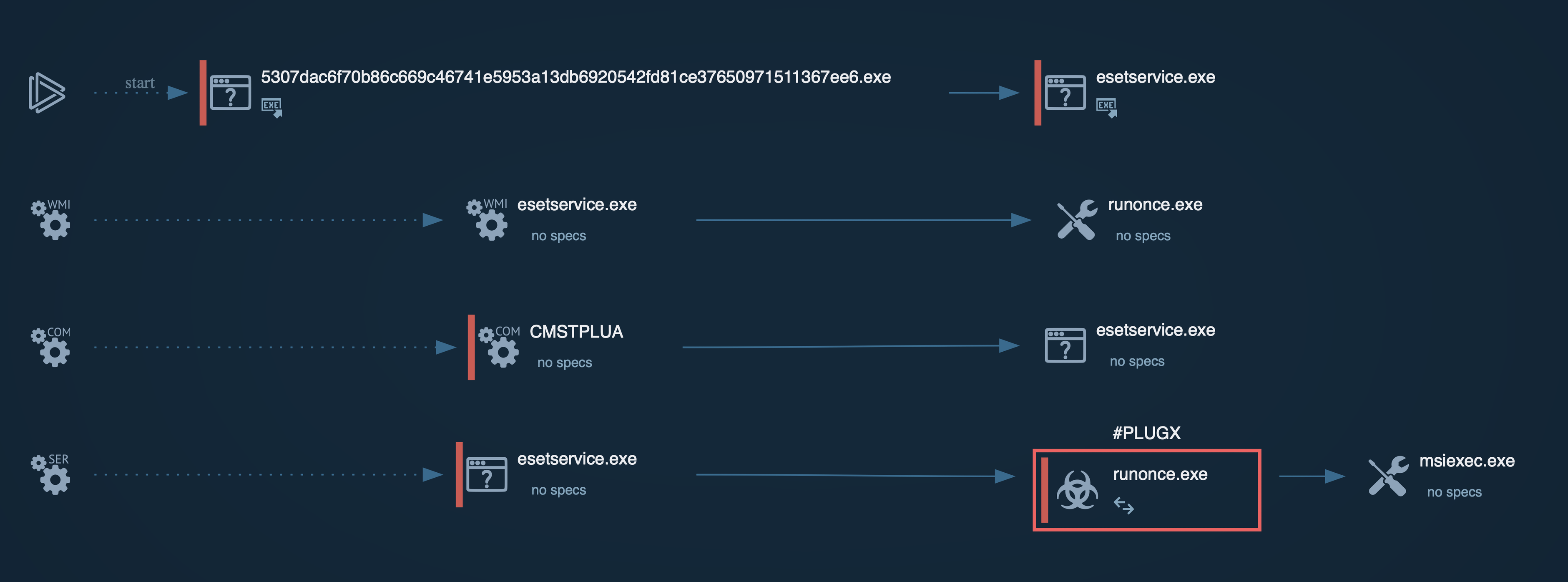
PlugX process graph in ANY.RUN PlugX`s process graph demonstrated in ANY.RUN

Distribution methods of the PlugX malware

Apart from USB-based distribution, PlugX is most often spread via phishing emails. Attackers usually place the malware inside an archive which is sent to victims in the form of an attachment. Once they open and launch the files inside the archive, the execution process begins.

Conclusion

PlugX is one of the most persistent threats in the world that has been actively used since 2008. Despite its long history, it regularly evolves, gaining new capabilities and features that allow it to beat defense systems. To make sure your organization remains safe from a PlugX infection, it is vital to keep up with the latest samples of the malware and its behavior. To this end, you can use ANY.RUN.

ANY.RUN is a cloud-based malware analysis sandbox that lets you investigate any threat to unveil its TTPs and collect IOCs. Thanks to its advanced interactivity, ANY.RUN makes it possible to conduct malware analysis by engaging with the malware and the infected system just like on a standard computer.

Try ANY.RUN for free – request a demo!
HAVE A LOOK AT

Havoc screenshot
Havoc
havoc
Havoc is an advanced post-exploitation framework used by hackers to take control of a system once they've breached it. With Havoc, attackers can run commands remotely, inject malicious processes, and access sensitive data. It's often used in targeted attacks, allowing cybercriminals to stay hidden in a network while stealing information or launching further attacks. Its flexibility and ability to bypass detection make it a serious threat, especially in environments that rely on traditional security tools.
Read More
WannaCry screenshot
WannaCry
wannacry ransomware
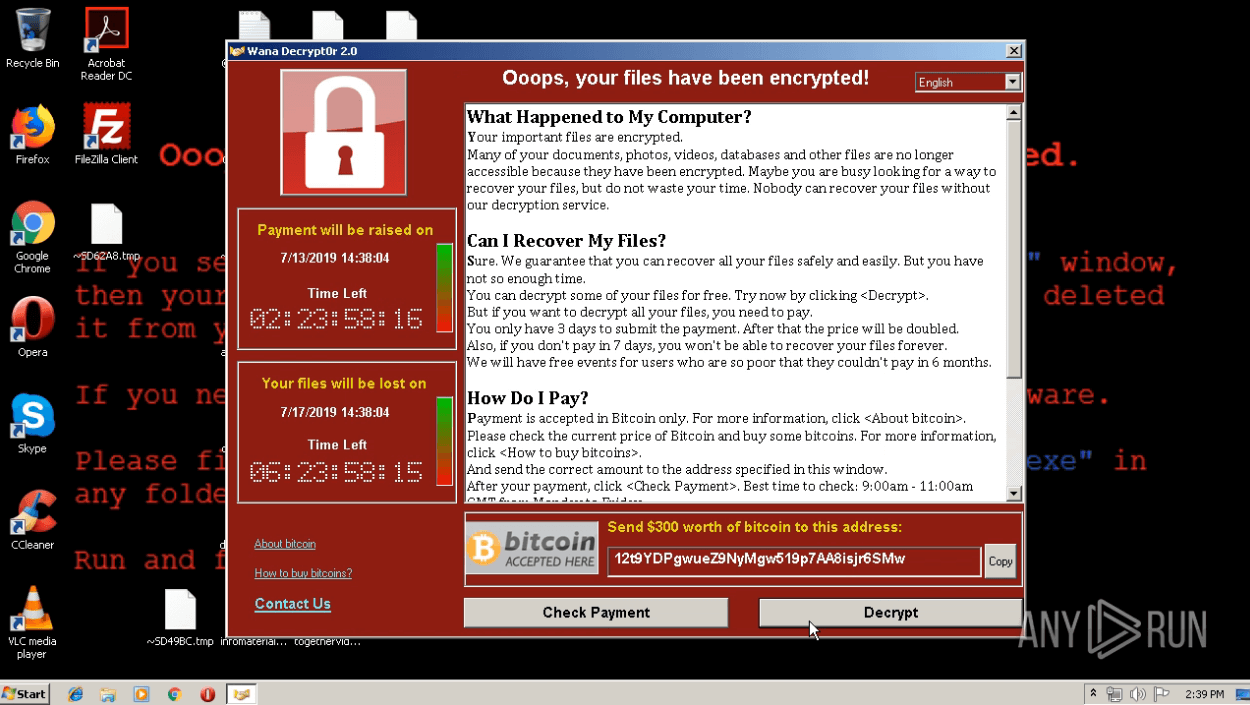
WannaCry is a famous Ransomware that utilizes the EternalBlue exploit. This malware is known for infecting at least 200,000 computers worldwide and it continues to be an active and dangerous threat.
Read More
 screenshot
Cephalus is a targeted ransomware threat discovered in 2025. It’s known for infiltrating organizations that deal with sensitive data through compromised RDP access. It leverages DLL sideloading with a legitimate SentinelOne executable. Cephalus is able to exfiltrate data and destroy backup options. Its payload is also tailored to each victim, which makes identification and mitigation more complex.
Read More
Arechclient2 screenshot
Arechclient2
arechclient2
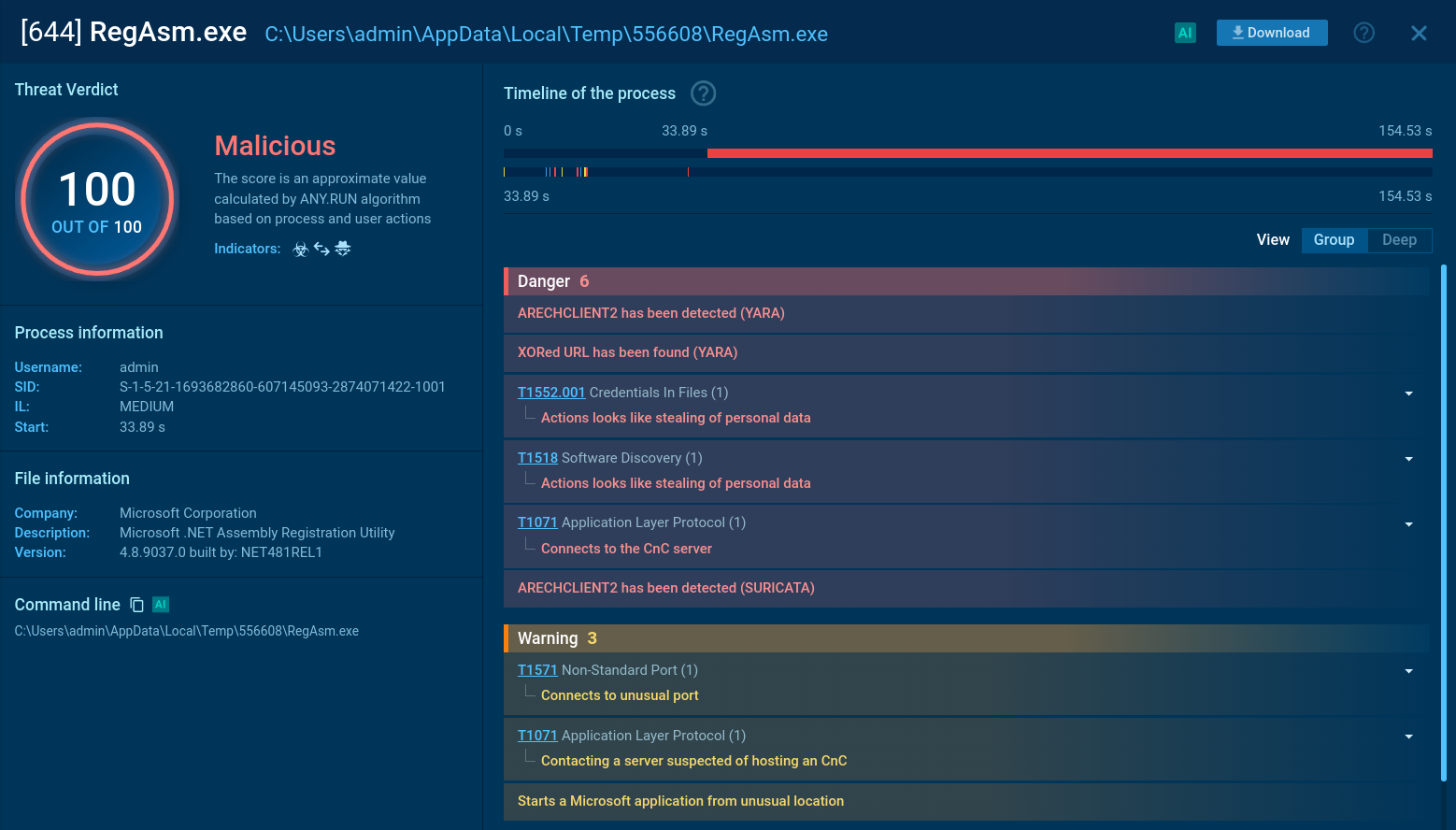
The Arechclient2 malware is a sophisticated .NET-based Remote Access Trojan (RAT) that collects sensitive information, such as browser credentials, from infected computers. It employs various stealth techniques, including Base64 encoding to obscure its code and the ability to pause activities to evade automated security tools. The malware also can adjust Windows Defender settings and uses code injection to manipulate legitimate processes.
Read More
Tykit screenshot
Tykit
tykit
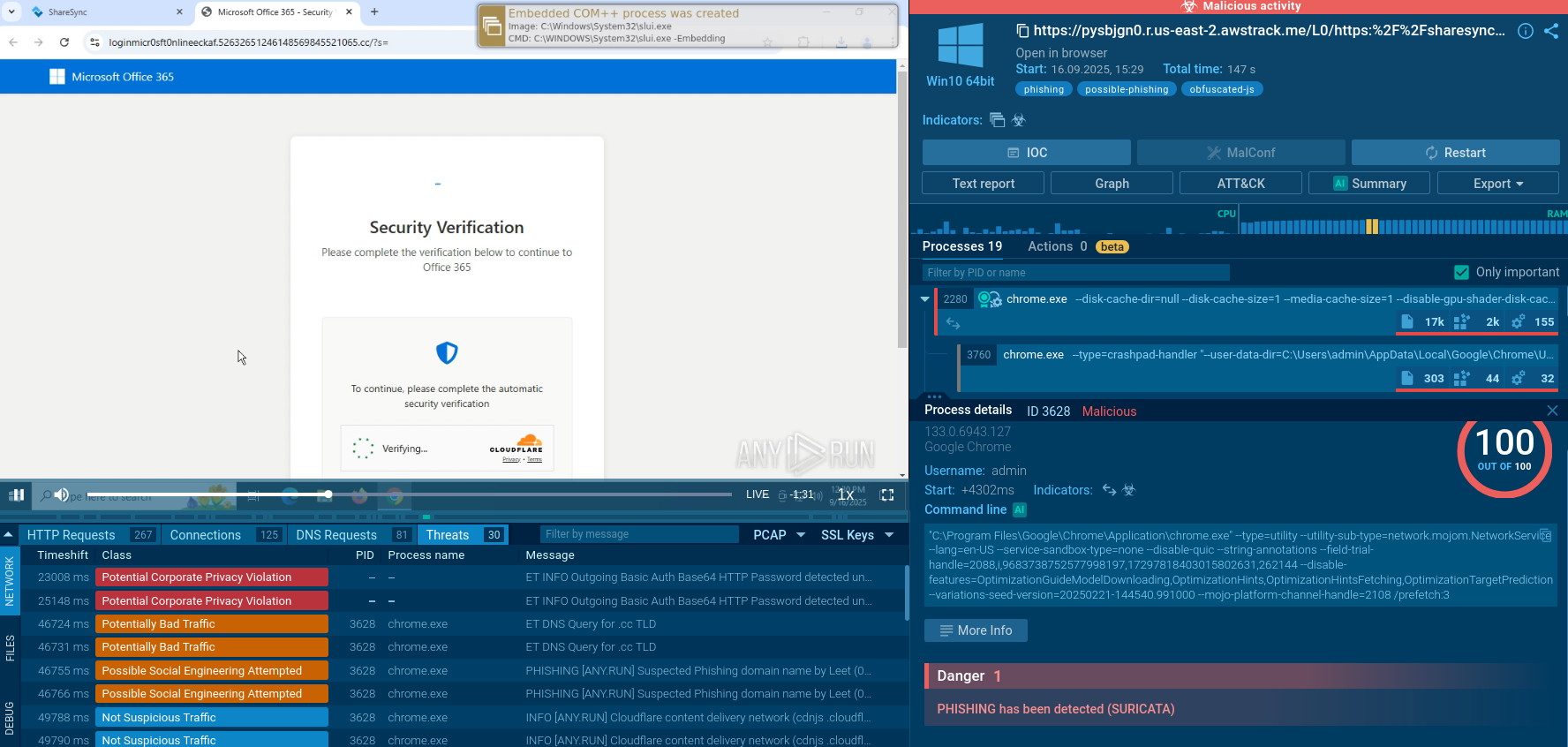
Tykit is a sophisticated phishing-as-a-service (PhaaS) kit that emerged in May 2025, designed to steal Microsoft 365 corporate credentials through an innovative attack vector: malicious SVG files.
Read More
Adware screenshot
Adware
adware
Adware is a form of malware that targets users with unwanted advertisements, often disrupting their browsing experience. It typically infiltrates systems through software bundling, malicious websites, or deceptive downloads. Once installed, it may track user activity, collect sensitive data, and display intrusive ads, including pop-ups or banners. Some advanced adware variants can bypass security measures and establish persistence on devices, making removal challenging. Additionally, adware can create vulnerabilities that other malware can exploit, posing a significant risk to user privacy and system security.
Read More